Podcast: John Henderson (’10)

Charleston School of Law

Podcast: John Henderson

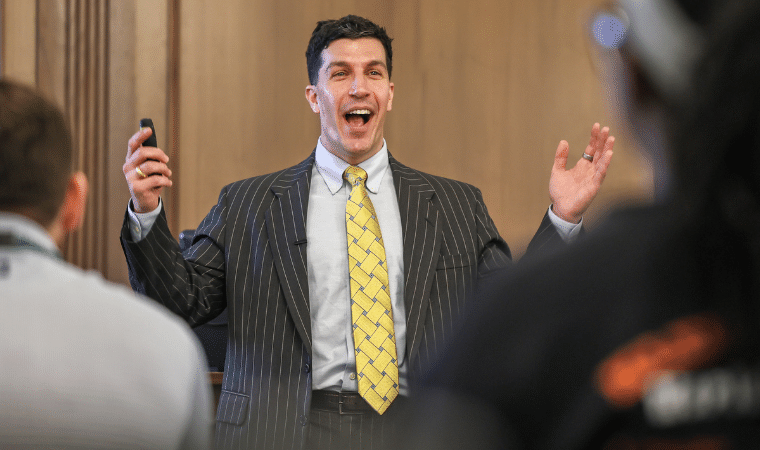
Charleston attorney John Henderson (’10) dropped by the Charleston School of Law Podcast studio this week. We sat down to talk about how his firm—Henderson & Henderson, LLC—is using AI in practice and how this burgeoning tech tool is reshaping the legal field, from staffing to research.

You can explore more Charleston Law podcasts on our Spotify channel @CharlestonLaw or in our archives at charlestonlaw.edu.

SHOW TRANSCRIPT

Charleston Law: We’re gonna talk today about AI in the law. It’s reshaping legal roles in the industry for contract review, for compliance, for e-discovery. What practices and policies does your firm use for AI?

John Henderson: We’re all in on using AI with parameters. One is, how do we get our lawyers to use it appropriately? It’s a tool. And two is, what do we do when our clients are just killing us with AI? You know, they’ve got all kinds of stuff going out there. So that’s the second issue that’s going on here, but let’s deal first with the lawyers and what we’re doing.

We set in place some guidelines. We use Harvey; we use Westlaw as an AI feature. We’ve got WealthCounsel. Paying a lot of money every month for access to these different services. Sure. And their AI tools are different. They give us a lot of information.

What we love is that we are 12 years old. Some law firms are over 100 years old. It lets us compete with this almost overnight. Wow. We can take somebody, a 46-year-old from Charleston School of Law, and they could compete very well with a 65-year-old with a UVA degree. We see this as an opportunity for us to close the gap between us and more sophisticated firms.

Charleston Law: What are you seeing on the client side?

John Henderson: They’re coming to you with a lot more AI-driven information.

Charleston Law: What does that do to the attorney-client relationship?

John Henderson: Everybody’s throwing things into Chat or Claude or Gemini … They’re getting some information. The more sophisticated buyers are saying, ‘This seems like… I don’t know. Let me just pay these guys to go figure out my problem.’ That’s what they’re here for. The less sophisticated buyers are trying to save a few dollars … So, AI really creates a lot of confusion, which can turn into discourse between client and attorney … So, one thing that we’ve tried to do with our clients is that now we’re giving them basically instructions on how to use AI themselves.

We’re saying, “Hey, we want you to be actively involved in your case. It’s your case. We’re here to assist you.” If you’re overusing AI, we’re gonna make a ton of money … we’re not trying to make more money off of this, so we tell them, “Let us use it; decide when we’re gonna use it and how we’re gonna use it to try to reduce your bill.” At the same time, we want them to be actively involved in their case, but AI tends to lead people down some weird paths. One example that comes to mind, a client who has paid us many tens of thousands of dollars. She sent us an eight-page document. Is this good to send to my family members who might come to the hearing?

How do we respond to things like this? This client sends us everything through AI, which raises other concerns. Is she killing privilege? We decided the best way to handle this is to address it on the front end and advise clients on how to use AI. This is what we expect from you. And then we also reserve the right to withdraw in any case where we feel like somebody is just overusing AI and being too combative with us. We’re gonna have you initial our engagement letter that we’re gonna step away from this because it makes it impossible if they’re just constantly fighting with us.

What I’m most concerned about is judgment. This is the thing that you just can’t replace. AI cannot give you judgment. We have people who need help. How do we help those people? And we have employees designed to help those people. You can’t replace that. Here’s what we’re trying to overcome and make sure it doesn’t happen.

I don’t want one of our lawyers to overuse AI, cut corners standing in front of a judge, or be at mediation and they don’t know some vital pieces of information because they relied too heavily on AI. They didn’t learn the little details about that case. I don’t want that to happen to us. That’s what it is for us. That’s when we must be on our game and know everything so we can properly advise our clients.

We are trying to make sure all our lawyers understand that the human element can’t be replaced. Research, fine. So, this is what we’ve told them. Draft everything yourself, ask our tools what you’ve left out, then decide what you want to include.

Charleston Law: What are the three most important things every law student must do to prepare for work in the legal industry?

John Henderson: Number one: Master communication. Number two: Tenacity. Number three: Learn judgment. Commit to that. First, master communication. This is with your colleagues, your bosses, your clients, other lawyers, the way that you’re communicating with them … understanding what your client really wants and needs. Simple things like when you get bad news, picking up the phone and calling them immediately … you need to take the time to learn these little nuances in the legal world: how do we communicate things?

You gotta develop this communication style so that you’re putting these things into emails the right way. You’re not rubbing people the wrong way. Right. So there’s a lot there. Pay attention, because it is probably the most important thing in your legal career.

And if you’re not great at making friends and doing all those things, it doesn’t matter. You still must learn to master this communication bit. Like, that’s just what the future of law is gonna be, ’cause guess what? We just have a bunch of robots that are in our legal offices … that are doing all the nerd work.

The second thing, tenacity. I’ve worked with a lot of smart lawyers who are lazy. Tenacity is gonna win all day long. When you start your legal career, be the first one in and the last one out. Those first few years, you’re gonna gain more knowledge; your bosses are gonna give you more stuff because they’re gonna be impressed.

Charleston Law: That’s something they don’t teach people. Bosses see that, but they don’t comment. They don’t say, ‘Hey, you need to be a little more tenacious.’

John Henderson: That’s right. If you’re getting your feelings too hurt because you got beat in one thing, then that’s a whole different problem … you just gotta take your lumps … keep fighting, keep your head up, and sometimes good things happen.

The third thing there is judgment. This is hard for law students. You haven’t had enough reps; there haven’t been enough hearings; there hasn’t been enough client communication. But knowing I don’t want to cut corners with AI, I don’t want it to do my job for me. Draft the memos. Draft the emails. Pick up the phone and call clients.

You’re gonna develop judgment, and you’re gonna be able to pick up the phone one day when you really need to, and you’re gonna call your client, and you’re gonna be able to say, “I know you want to do this. That’s a dumb idea. Let me tell you what we’re gonna do.” That’s what they want … if you’re super focused on not cutting corners and doing everything the right way, that judgment will come sooner; clients will trust you.

Then, understanding what the client really wants. Really leaning into understanding how to read people- yeah… and what they really want… A lot of emotions are going on. You’re trying to peel back the layers of the onion and figure out what they really want. At first they just want to fight.

John Henderson: Were there opportunities at Charleston School of Law that you think laid the foundation for you to understand what kind of attorney you wanted to be?

John Henderson: It’s a great question, because I didn’t do law school right. I wish I had.

Charleston Law: Would you do it differently?

John Henderson: Yes. This is what I tell my kids. Go to law school if you think you’re gonna be in the top 20%. It’ll make your life easier. In law school, those summer jobs and clerkships are way more important than I valued them at the time. I just wish I had leaned into working at law firms a lot more. There are a ton of lawyers in this town. There are opportunities to get work experience.

Charleston Law: Experiential learning here at Charleston School of Law looks like this: internships, externships, clinics, pro bono opportunities, all the advocacy programs here on campus, and networking opportunities that are going to give you a well-rounded understanding of the legal industry, both at large and here in Charleston, and opportunities to network and prepare yourself for that day when you graduate and go take the bar.

Related Posts

USCG

Coast Guard and Harbor Pilots visit Maritime Law class

Charleston Law welcomed guest speakers from the U.S. Coast Guard and Charleston Harbor Pilots to speak to the Global Trade and Maritime Law LLM Intermodal Container Transportation Law class.

The Anatomy of a Court-Martial

Charleston Law welcomed United States Marine Corps Captain Tyler Patrick on Thursday. Capt. Patrick shared "The Anatomy of Court-Martial" with students.

Legal community hosts ‘A Courthouse Thanksgiving’ for law students

Charleston School of Law Career Services is partnering with the United States District Court for the District of South Carolina, Charleston Division, for a Thanksgiving gathering.