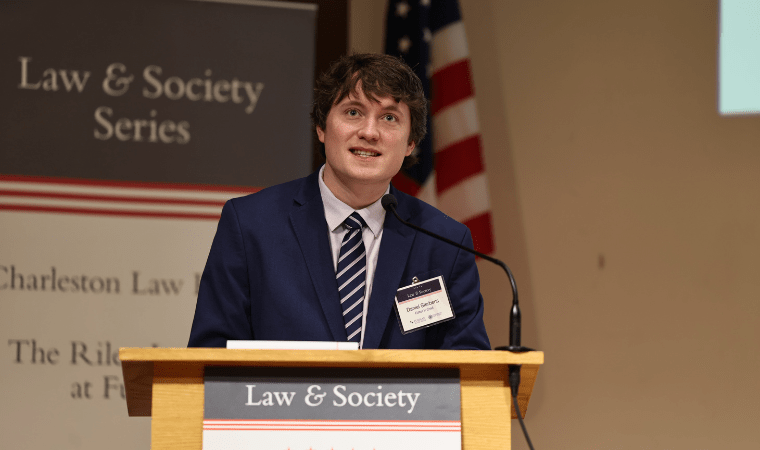
Charleston School of Law welcomed The Honorable Judge Richard Gergel back to campus last week to discuss his seminal book, Unexampled Courage: The Blinding of Sgt. Isaac Woodard and the Awakening of President Harry S. Truman and Judge J. Waties Waring.
The book details the impact of Sergeant Isaac Woodard’s blinding on the racial awakening of President Truman and Judge Waring and traces their influential roles in shaping the course of America’s civil rights history.
On February 12, 1946, Sergeant Isaac Woodard, a returning, decorated African American veteran, was removed from a Greyhound bus in Batesburg, South Carolina, after he challenged the bus driver’s disrespectful treatment of him. Woodard, in uniform, was arrested by the local police chief, Lynwood Shull, and beaten and blinded while in custody.
President Harry Truman was outraged by the incident. He established the first presidential commission on civil rights, and his Justice Department filed criminal charges against Shull. In July 1948, following his commission’s recommendation, Truman ordered an end to segregation in the U.S. armed forces. An all-white South Carolina jury acquitted Shull, but the presiding judge, J. Waties Waring, was conscience-stricken by the failure of the court system to do justice to the soldier. Waring described the trial as his “baptism of fire” and began issuing major civil rights decisions from his Charleston courtroom, including his 1951 dissent in Briggs v. Elliott, in which he declared public school segregation per se unconstitutional. Three years later, the Supreme Court adopted Waring’s language and reasoning in Brown v. Board of Education.
Following his keynote message, Judge Gergel sat down with Charleston Law Professor Allyson Haynes-Stuart for a Q&A. The following are edited excerpts from the conversation:
Professor Allyson Haynes-Stuart: A tremendous amount of research went into writing Unexampled Courage. What got you interested in this story?
Judge Richard Gergel: There’s a period between the time I was nominated and confirmed, and I was winding up my practice. I knew I was coming to Charleston, and vaguely knew about Judge Waring, so I started looking into the story.
There was a fair amount of writing about Judge Waring. He was a national figure in the ‘40s, and he would frequently tell reporters, ‘He developed a passion for justice.’ Nice sentence, but what does that mean? Because there were other federal judges around the South who apparently did not have a passion for justice. What was it? That question kind of nagged me. What would be my role as a judge, and what can I learn about what has changed? So that really piqued my curiosity about what this case was all about.
After reading for a while, I had this hypothesis that there was an odd case on his docket from 1946 involving the beating and blinding of a black soldier. Believe me, at the time, the Department of Justice had not brought cases like that.
I’d found a letter Judge Waring wrote in 1945, advocating a gradual change in Southern culture … We need to change things, but we need to do it organically. The South needs to do it. They don’t need to be influenced by outside agitators. By 1947, he was threatening to lock up Democratic Party executive committee members for two years.
I was zeroed in on this case, which was between that letter and the Elmore case, and a family member of Judge Waring, a great nephew, said to me, ‘I’ve been interviewed by Ruby Cornwell (a matriarch of the Charleston Civil Rights community in the ‘40s and ‘50s), asked if I would like to listen to the tape? And one Saturday morning, I’m sitting in my office, headphones on, listening to a 100-year-old woman describing her relationship with Waites and Elizabeth Waring. Then, in the middle of this discussion, she says, ‘You know what changed him, don’t you?’ I said, ‘Whoa, here it is.’ She said, ‘He told me it was that blinded negro soldier. It was his baptism of fire.’ And there it was.
There’s a whole story about Harry Truman being dramatically influenced by the story, and for years afterwards, whenever Truman spoke about civil rights, he would mention the blinding of Isaac Woodard.
So, here was the irony: Once I figured out Truman’s role, here were the two major events of the early Civil Rights Movement post-war: the desegregation of the United States Armed Forces and Brown v. Board of Education, both influenced by the blinding of Isaac Woodard.
Professor Allyson Haynes Stewart: What can we learn from these individuals?
Judge Richard Gergel: There’s a very interesting YouTube video. I invite people to look at it. It is from 1957. Judge Waring had retired and was on a public television program with a 27-year-old minister named Martin Luther King. It was his first national broadcast.
The two of them together; it is remarkable. It’s very clear that Judge Waring admired King, and Dr. King has great respect for Judge Waring, who says, ‘People must stand up for themselves. They must assert their rights. We can’t do that for them. They must come, and it sometimes might put them at risk, but if they don’t stand up for their rights, no one will protect them.’
I think one of the most interesting parts of this story is the changes in Judge Waring personally; the way you describe it comes from your personal experience in that courtroom, seeing what happened.
What do you think personally led him to this change?
There’s this view that white southerners were all of one mind on race, and that just really wasn’t true. There were some people — very vicious, racist — who would engage in lynching. So, it’s sobering to know that there are some very bad actors out there, but there were white southerners intimidated by the segregationists not to speak up, who thought that the South needed to change and address these matters.
And though they can often be squishy moderates about these things, they were clearly very intimidated by the reaction they would get if they even suggested change … So, there was a feeling among the segregationists that any division in the white community was an existential threat to the racial status quo. They viewed any white descent as a mortal danger to the South. Waring was their nightmare opponent. He had life tenure. He was guarded by US marshals with guns. He was fearless.
It highlights the point you raised before: people need to stand up. People need not be intimidated. All it takes is good people to be silent, for bad things to happen. We have a new kind of danger here where people might not actually get the facts. People disagree about what facts are … it’s very troubling. We are in the fact-finding business, right?
The folks in this room, some will be members of a bar. A law license is a license to do good. And wherever you work, whatever kind of work you are in, you can use that license to promote good.
I will say that in the spirit of advocacy, some will be more imaginative about what the facts are, and that really requires us as judges to be prepared and to study the record in front of us carefully. There may be a temptation, when you’re an advocate, to stretch the truth and advance what you think is a bigger cause, and I urge you not to do that because your reputation as a reliable and honorable person is extremely valuable. If you develop a reputation for being untrustworthy, it is very damaging to your legal career.
Professor Allyson Haynes Stewart: We know that today, there are federal judges being vilified and threatened because of their opinions. What do you think this story says to judges who are facing the same crisis of courage?
Judge Richard Gergel: I speak to a lot of different groups, and among the groups are federal and state judges. They find a special resonance in this story because Judge Waring really was the first of what became a pattern in the 50s. But then, after Eisenhower appointed judges, particularly in the South, Frank Johnson (Alabama), and judges on the Fourth Circuit Court of Appeals, they got similar treatment, Skelly Wright (New Orleans).
Friends wouldn’t speak to them. Constant threats … and needing security protection. But I’m afraid we’re back to where we were. A colleague from New Jersey had someone come to her house and kill her son on his 21st birthday … and shot her. There’s a sobering reality here that when judges stand up for the rule of law and the rights of all citizens, they put their safety in jeopardy from time to time.
Professor Allyson Haynes Stewart: On the note of legal careers, what advice do you give them?
Judge Richard Gergel: One: If you want to clerk for a judge, and two: if they want to become one. If you want to be a judge, be a good lawyer. Judge Matthew Perry, who was a colleague of mine and was sort of Thurgood Marshall of South Carolina, told me this story that when he was a third-year law student, a professor asked him, ” Well, Perry, what do you want to do when you go out into practice? Perry said, ‘I want to be a civil rights lawyer.’
The professor replied, ‘Perry, first learn how to be a lawyer,’ and Judge Perry took that advice. He went to Spartanburg. For years, he tried small cases, handled divorces, did title searches, learned how the tools of law worked, and when he finally got his big case, he was ready. So, the idea is that you can just walk out, know what to do, and get the big case … that doesn’t exist.
Judge Gergel, a native of Columbia, South Carolina, earned his undergraduate and law degrees from Duke. In December 2009, he was appointed to a seat on the US District Court District of South Carolina by President Obama and was confirmed to the bench just under a year later.
Judge Gergel has written extensively about the history of people across the state and how the law has influenced our communities.
inspired the PBS American Experience documentary, The Blinding of Isaac Woodard.