Related Posts

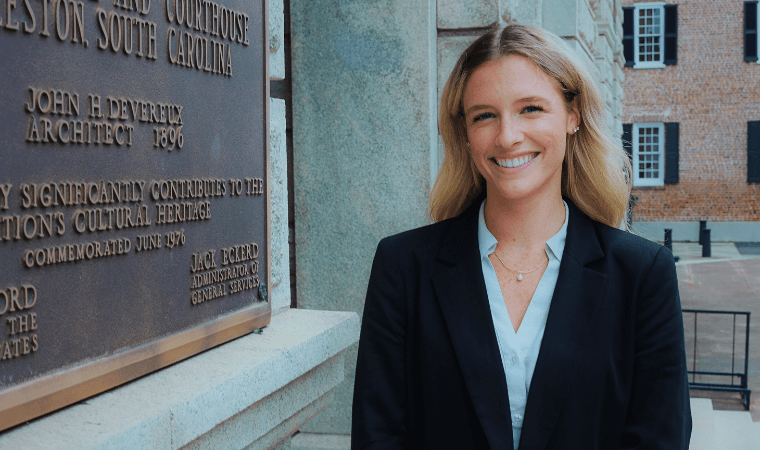


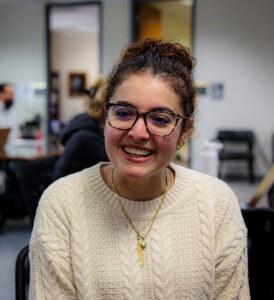 Charleston School of Law 3L Jacqueline Vega-Gonzalez recently completed her one-year term as a Law Student Advisor for the South Carolina Access to Justice Commission, making her the first student at the School to participate in the program.
Vega-Gonzalez, a Columbia, South Carolina native, earned her undergraduate degree in Criminal Justice with a minor in Psychology from the University of South Carolina. Since arriving at Charleston Law, Gonzalez has established herself as a leader both in and beyond the classroom, serving on the Trial Advocacy Board and as Vice President of the Alliance for Equality student organization.
“I didn’t know the Access to Justice Commission existed,” she said. “It was new to me, but it was refreshing to know that something’s being done to help people in need.”
Hannah Honeycutt, Executive Director of the South Carolina Access to Justice Commission, said the program provides an important foundation for transitioning to the legal profession by deepening a law student’s understanding of how the legal system functions for people without resources, representation, or familiarity with the courts. This perspective is crucial to a meaningful and impactful career in the law, regardless of practice setting.
“Through this experience, Jacqueline and all our law student advisors gain a stronger grasp of the realities of the justice gap, the importance of collaborative problem-solving, and the role lawyers must play in expanding access to justice,” said Honeycutt.
“It’s not about money,” said Gonzalez. “I think the greatest wealth in life is being happy. I think culture equates success with money and material things. You can have those things, but if you’re not happy, then what is the point? I think what’s important is helping others and being passionate about the work.”
The work soon became personal for Gonzalez, who said she had a family member in a similar position.
“There are people who can’t get an appointed attorney and cannot afford one,” she said. “They struggle to raise the money to pay an attorney. I brainstormed ways to provide access to legal services for people who can’t afford an attorney. That was the highlight of my time with Access to Justice.”
I’m very grateful to be where I am now. I don’t really come from a family background with much education. I have been fortunate to be here. It’s a big deal to me.

In November of her 2L year, Gonzalez accepted a position as a law clerk at Chris Jacob Family Law.
“I wanted to get my foot in the door because you never really know until you try,” said Gonzalez. “I tried it, and I just fell in love with the work.”
The opportunity gave Gonzalez hands-on experience working with indigent people in need of an attorney. The opportunity to have a seat at the table was a valuable lesson, she said.
“She [Hannah Honeycutt] does an amazing job putting the meetings together,” said Vega-Gonzalez. “If you just watch her, it is very clear how passionate she is about the work. I admire her passion. I consider myself a very passionate person, and experiencing that was all worth it.”
Gonzalez said the experience of being part of a group of attorneys leading programs to bring services to those in need was eye-opening for her. “I was not aware of how small South Carolina is in terms of the number of attorneys, especially in rural areas,” she said. “People in small towns also need attorneys.”
Vega-Gonzalez combined her passion for justice and her knowledge of the law to assist attorneys in drafting statewide guidelines.
“She was consistently thoughtful, engaged, and reliable,” said Honeycutt. “She approached access to justice issues with empathy and a clear awareness of the barriers low-income people face when navigating the legal system. She listened carefully, asked insightful questions, and contributed in a way that reflected both maturity and a sincere commitment to the Commission’s mission.”
Margaret M. Lawton, Vice Dean, Associate Dean and Professor of Law, who serves on the Access to Justice Commission, agreed with Honeycutt’s observations of Vega-Gonzalez’s time on the Commission. “Ms. Vega-Gonzalez was also an excellent representative of the law school. Commission members were impressed with her understanding of the legal issues facing South Carolinians.”
It is the combination of those skills – empathy, awareness, maturity – that led Dylan O. Malagrinó, Associate Dean for Faculty Research and Development and Professor of Law at the Law School, to nominate Vega-Gonzalez as the Charleston Law student liaison. “Ms. Vega-Gonzalez is an outstanding campus leader at Charleston Law, with a strong work ethic and an extraordinary interest in public service, he said. “I am confident the work she has done as a law student advisor to the S.C. Access to Justice Commission will help ensure equal access to civil legal assistance for all South Carolinians.”
Charleston School of Law is an ABA-accredited 501(c)(3) law school nationally recognized for its student-centric culture. Our faculty and staff are committed to preparing you for success in both the classroom and the legal profession.
SCATJ brings together a broad range of legal system stakeholders—judges, court leaders, private lawyers, legal aid providers, policymakers, and funders—who work to address the significant civil justice gap in South Carolina by assessing essential civil legal needs, fostering collaboration, and identifying innovative solutions.



Mental health clinician Briana Suhr is a valuable Wellness resource for students and will have office hours every Tuesday in the Student Affairs suite on the 1st floor from 10 am - 4 pm.

Charleston School of Law will be in attendance at the LSAC Digital Forum on Thursday, February 10 from 5:00 p.m. – 8:00 p.m.